
How Technology Is Changing Mental Training in Tennis
For decades, the mental game was the one part of tennis you couldn't see, schedule, or measure. That is finally changing — and it's reshaping how players, coaches, and programs train the mind.
Walk into any serious tennis program today and you'll find technology everywhere. Ball-tracking cameras chart every rally. Sensors log racquet-head speed and spin. Video breaks down a service motion frame by frame. Fitness wearables report on sleep and recovery before a player even reaches the court. And then there's the mental game — the part everyone agrees decides close matches — still handled, in most places, with a pep talk and a hopeful look.
That gap has existed for a simple reason: the mind is hard to observe. You can film a forehand. You can't film the moment a player starts doubting their second serve at 4–5 in the third set. For generations, mental training lived in the occasional sports psychology appointment, a book on the nightstand, or whatever wisdom a coach could squeeze in during the changeover.
But the tools that transformed the physical and technical sides of tennis are now reaching the mental side — and they're changing not just how mental skills are taught, but who gets access to them, how often they're practiced, and how coaches can actually see progress. Here's what that shift looks like.
Why the Mental Game Lagged Behind
Every other dimension of player development got a technological upgrade because it had something to measure. Speed, spin, footwork patterns, and heart rate all produce numbers, and numbers invite tools. Mental performance, by contrast, has always been internal, subjective, and fleeting. A player might feel nervous, distracted, or flat, but by the time they could describe it, the match was over and the feeling had faded.
Access was the other barrier. Working with a sport psychologist has traditionally meant scheduled sessions, real cost, and travel — resources concentrated at the top of the sport. The junior at a local club, or the high school player juggling homework and tournaments, has usually been left to figure out the mental game alone. Technology is starting to remove both obstacles at once.
“You can film a forehand. You can't film the moment doubt creeps in at 4–5 in the third. That's the gap technology is finally closing.”
Five Ways Technology Is Reshaping Mental Training
1. From the Office to the Pocket
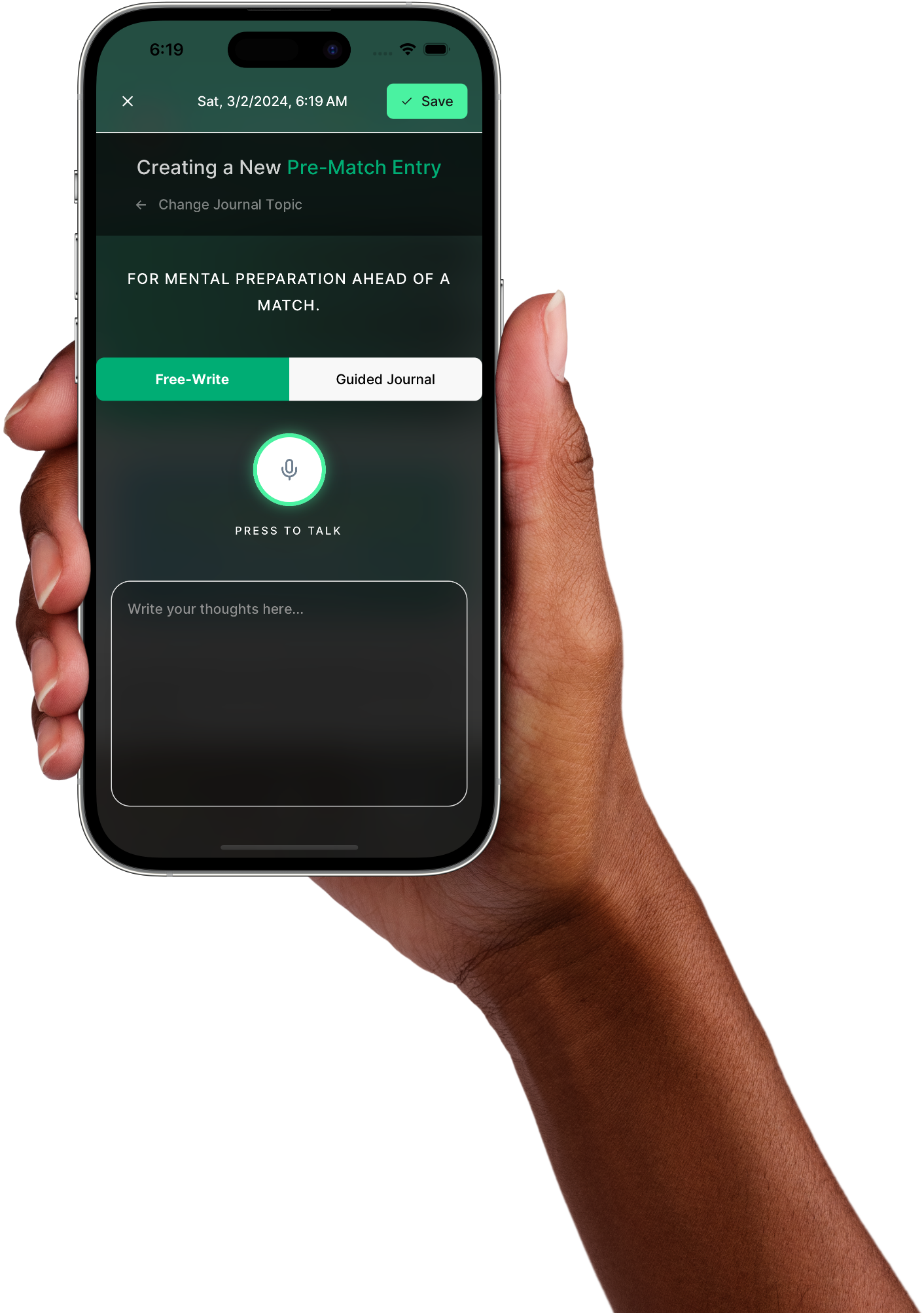
The most basic change is also the most powerful: mental training now travels with the player. Guided breathing, pre-match visualization, focus routines, and reset techniques that once required a session with a specialist can live on a phone — available in the car on the way to a tournament, in the hallway before a match, or on the bench during a rain delay.
That matters because mental skills are most useful in the exact moments when no expert is around. When the tools are in the player's pocket, the training happens where the pressure actually is, not in an office days later.
2. From Memory to Patterns
Ask a player how they felt before last month's tournament and you'll usually get a shrug. Ask them to log a quick mood check-in or a few sentences of post-match reflection every time they compete, and something remarkable emerges over a season: patterns. Maybe their confidence dips after poor sleep. Maybe they consistently play tight against lefties, or loosen up only after the first set.
Digital journaling and simple check-ins turn fleeting feelings into a record. That record gives players self-awareness they couldn't build from memory alone — and gives coaches something concrete to work with, rather than impressions and guesswork.
3. From Occasional Workshops to Daily Reps
Nobody expects a backhand to improve from a single clinic a season, yet that's how mental training has often been delivered: an inspiring workshop, a burst of motivation, and then nothing until the next one. Skills like focus, emotional regulation, and self-talk only stick through repetition.
Technology makes repetition realistic. Short, structured sessions of a few minutes, combined with habit tracking and streaks, help players build the mental game the same way they build everything else — consistently, in small doses, over time. The streak on the screen isn't the point. The habit underneath it is.
4. From Waiting for an Appointment to Support On Demand
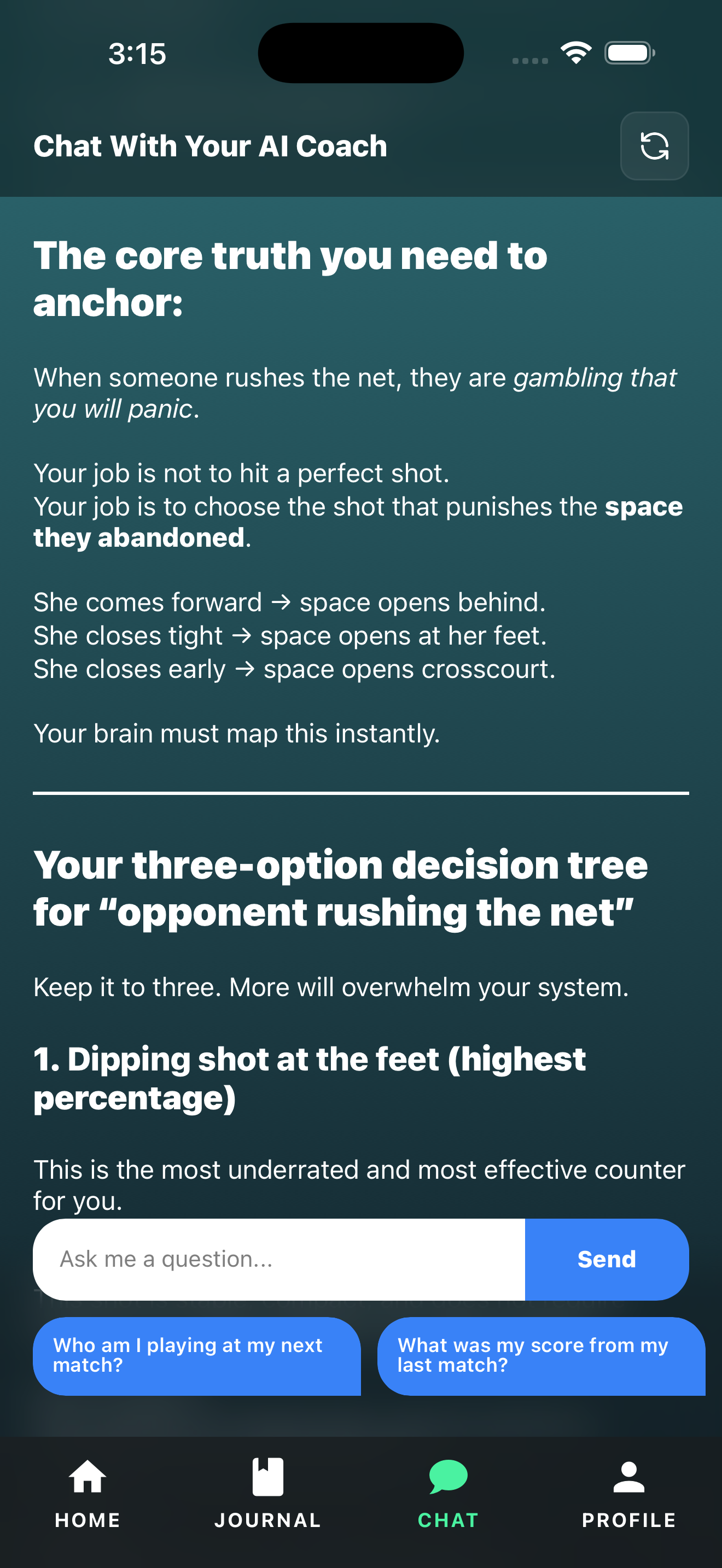
The hardest mental moments rarely arrive during business hours. They show up at 10pm after a frustrating loss, on the drive home from a tournament, or the night before a big match when sleep won't come. AI coaching tools trained on sound sports psychology principles can now meet a player in those moments — helping them talk through a result, reframe a setback, or prepare a game plan for tomorrow.
This doesn't replace a skilled human coach or a licensed professional. What it does is fill the long stretches between conversations with something genuinely useful, so a player isn't left alone with their own spiral until the next lesson.
“The hardest mental moments rarely happen during a lesson. They happen at 10pm, on the drive home, with no one to talk to.”
5. From Guesswork to a Shared Language
Coaches have always tried to read their players’ mental state from body language and results. That instinct is valuable, but it's incomplete — especially for a program director overseeing dozens of athletes. When players regularly reflect and check in, coaches can see trends across a roster: who's been carrying stress for weeks, whose confidence is quietly rebuilding, who might need a conversation before the next tournament.
Just as importantly, it gives players and coaches a shared vocabulary. Instead of “you looked off today,” the conversation becomes “I noticed your focus scores slip in long matches — let's work on that.” Mental training stops being vague and becomes something the whole team can talk about openly.
The Wider Landscape
Mobile platforms are only one part of the picture. Some programs are experimenting with wearables that track heart-rate variability as a window into stress and recovery. Biofeedback tools help players see, in real time, how their breathing shifts their physiology. Virtual reality is being explored as a way to rehearse high-pressure scenarios before they happen. Video analysis increasingly looks at between-point behavior — routines, posture, reactions after errors — not just strokes.
Not every one of these tools will prove its worth, and not every program needs all of them. But the direction is clear: the mental game is becoming something you can practice deliberately, observe over time, and support with the same seriousness as the physical game.
What Technology Can't Replace
For all of this progress, the best mental training still rests on human relationships. A coach who knows a player well, a parent who responds to a loss with perspective, a teammate who keeps things light before a final — none of that is replaceable, and none of it should be. The right technology doesn't compete with those relationships. It strengthens them, by giving players more reps and giving the adults around them better information.
It's also worth using these tools with intention. The goal isn't more screen time or another number to obsess over. It's a player who understands themselves better, recovers from setbacks faster, and walks onto court with a mind that has been trained as deliberately as their forehand.
Where Tennis IQ Fits In
Tennis IQ® brings every one of these shifts into a single platform built specifically for tennis. Players get guided mindset sessions they can use anywhere, quick post-match journaling and mood check-ins that reveal their patterns over time, streaks and habit tracking that turn mental training into a daily rep, and an AI coach grounded in real sports psychology for the moments between lessons. Coaches and programs get visibility into how their players are actually doing — and a shared language for the conversations that matter.
Where It's Heading
Tennis has spent decades getting extraordinarily good at measuring and training what happens with the body and the racquet. The next frontier is the part of the game that has always decided the tightest matches. As mental training becomes more accessible, more consistent, and more visible, it stops being a luxury reserved for touring pros and becomes part of everyday development — for the junior at the local club as much as the academy prospect.
“The next generation of players won't just have better data on their strokes. They'll have trained minds to match.”
For coaches and program leaders, the opportunity is simple: give the mental game the same structure, tools, and attention you already give everything else. The players who grow up training their minds this way won't think of it as something extra. To them, it will just be part of how tennis is played.
Bring your mental training into the modern game.
Give your players an always-on mental coach that turns focus, resilience, and confidence into daily habits. Free to download, with a 14-day free trial.
Available on iOS • Android coming soon